Copy deck
The owner's final deck sets six messages in a fixed order; the screenshots and the video both follow it. Below: the final deck, how it got there, the 40 headline options from ten copywriting methods, and each writer's reasoning with its compliance memo.
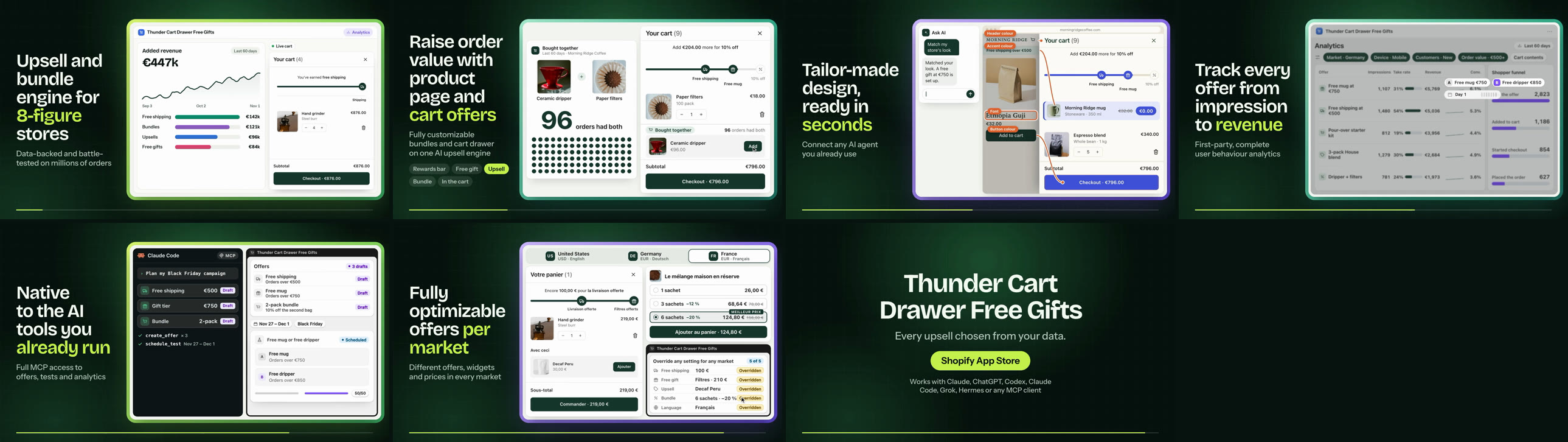
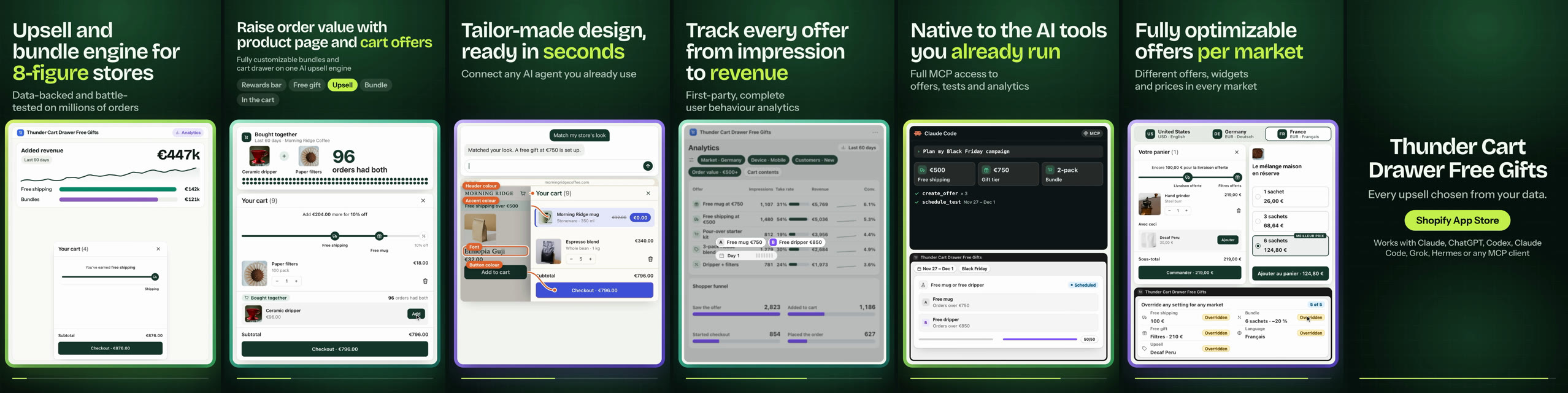
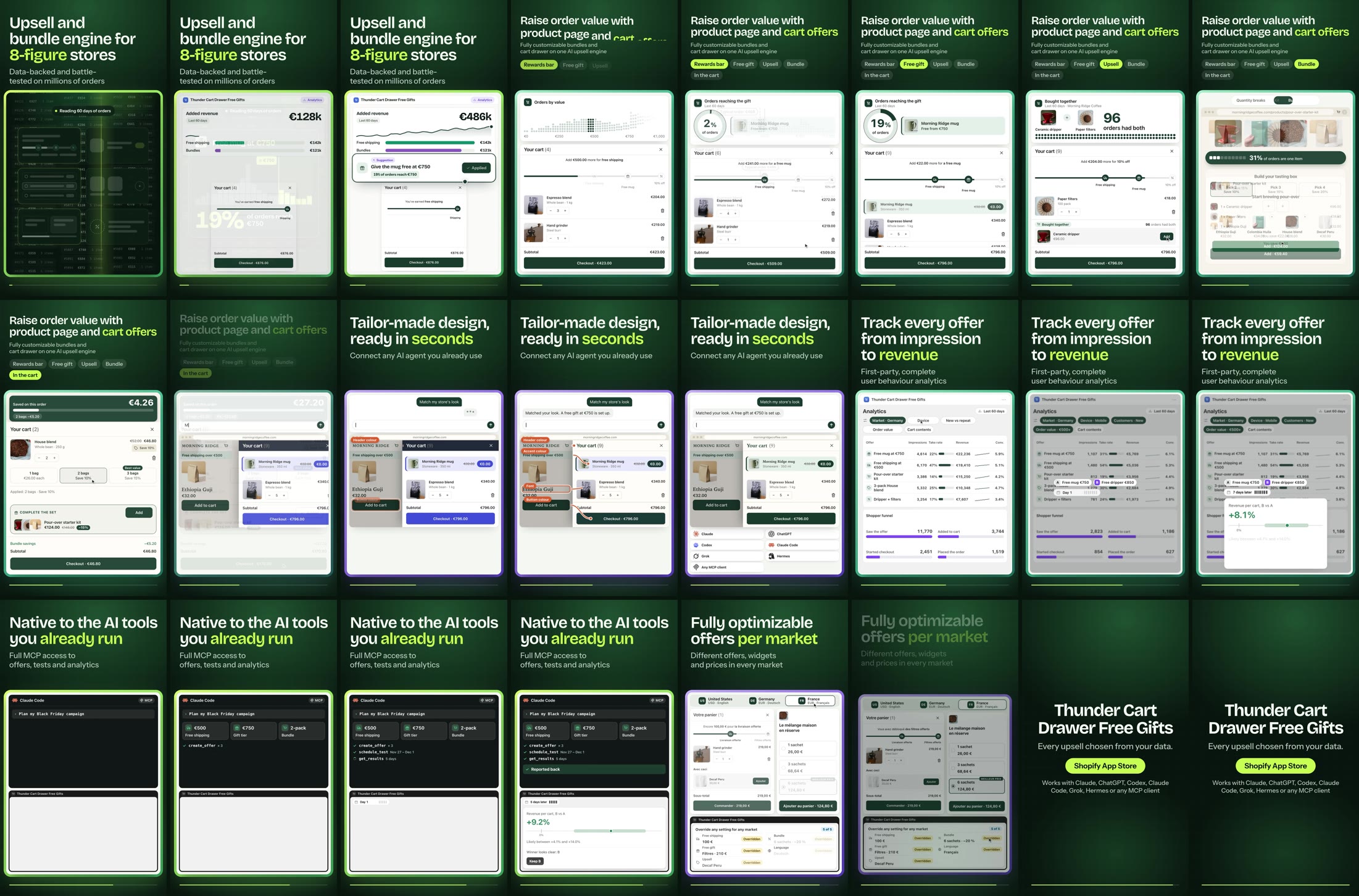
FINAL deck (owner, 2026-11-01): six slides, the video follows the same six messages
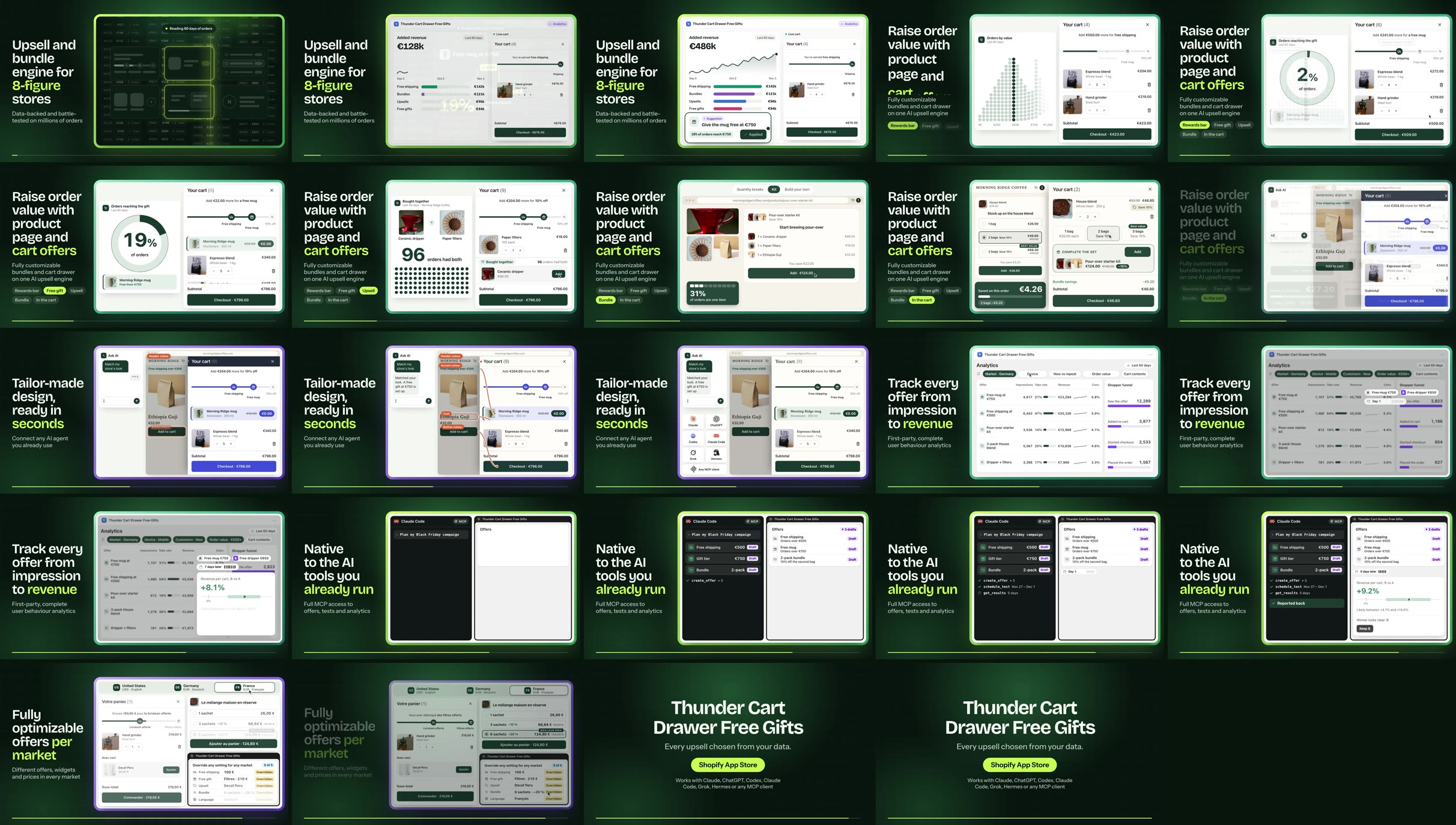
FINAL deck: listing screenshots + video (G, 2026-11-01)
Six slides, 1600x900. The video follows the same six messages in the same order.
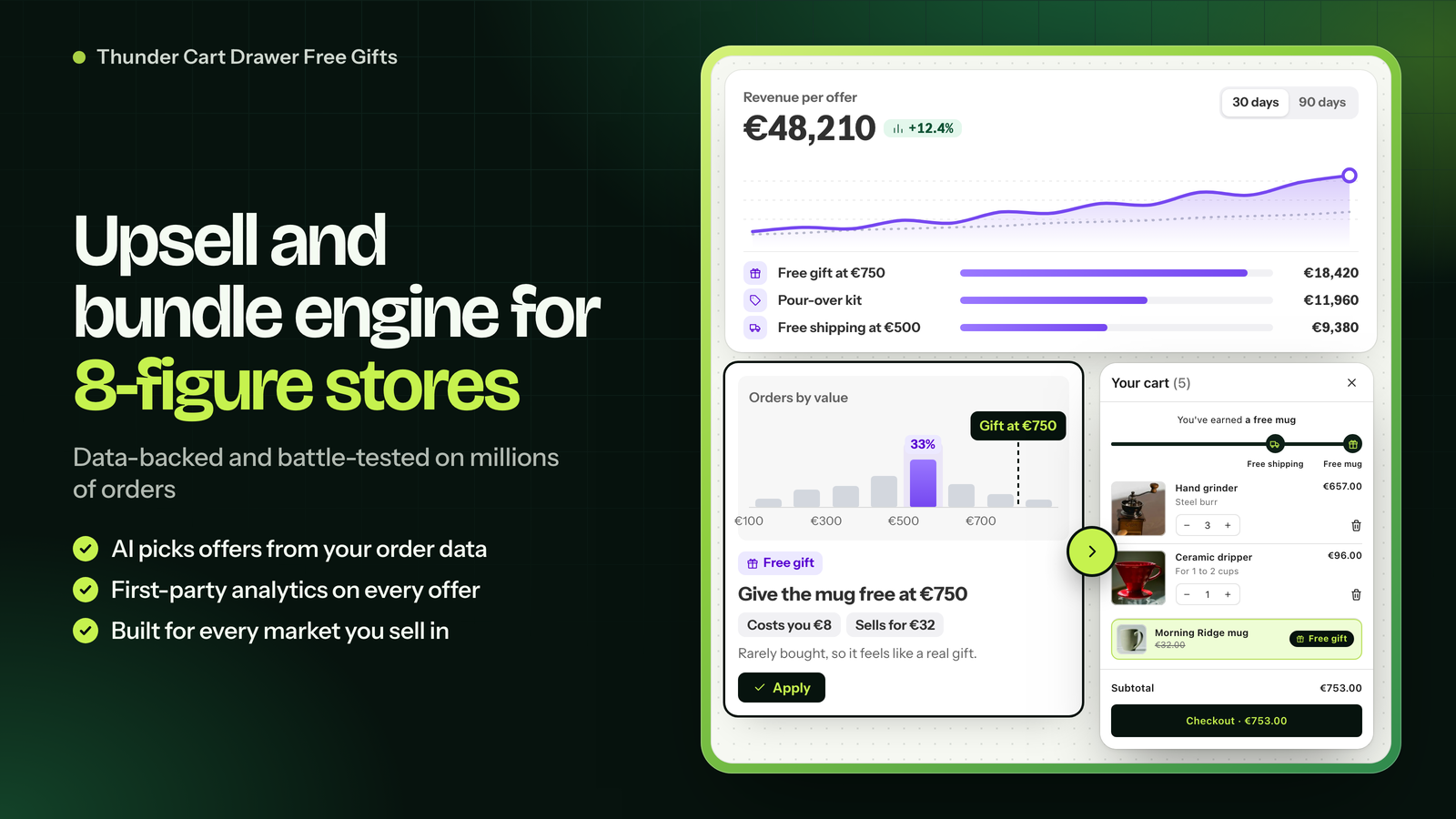
1. Run your cart and bundles like an 8-figure store
Subtitle: A data-backed upsell engine, battle-tested on millions of orders
Bullets:
- AI picks offers from your order data
- First-party analytics on every offer
- Built for every market you sell in
Creative: a polished analytics dashboard with revenue per offer and a trend line, overlaid with the AI suggestion card (offer + reason), and the cart drawer.
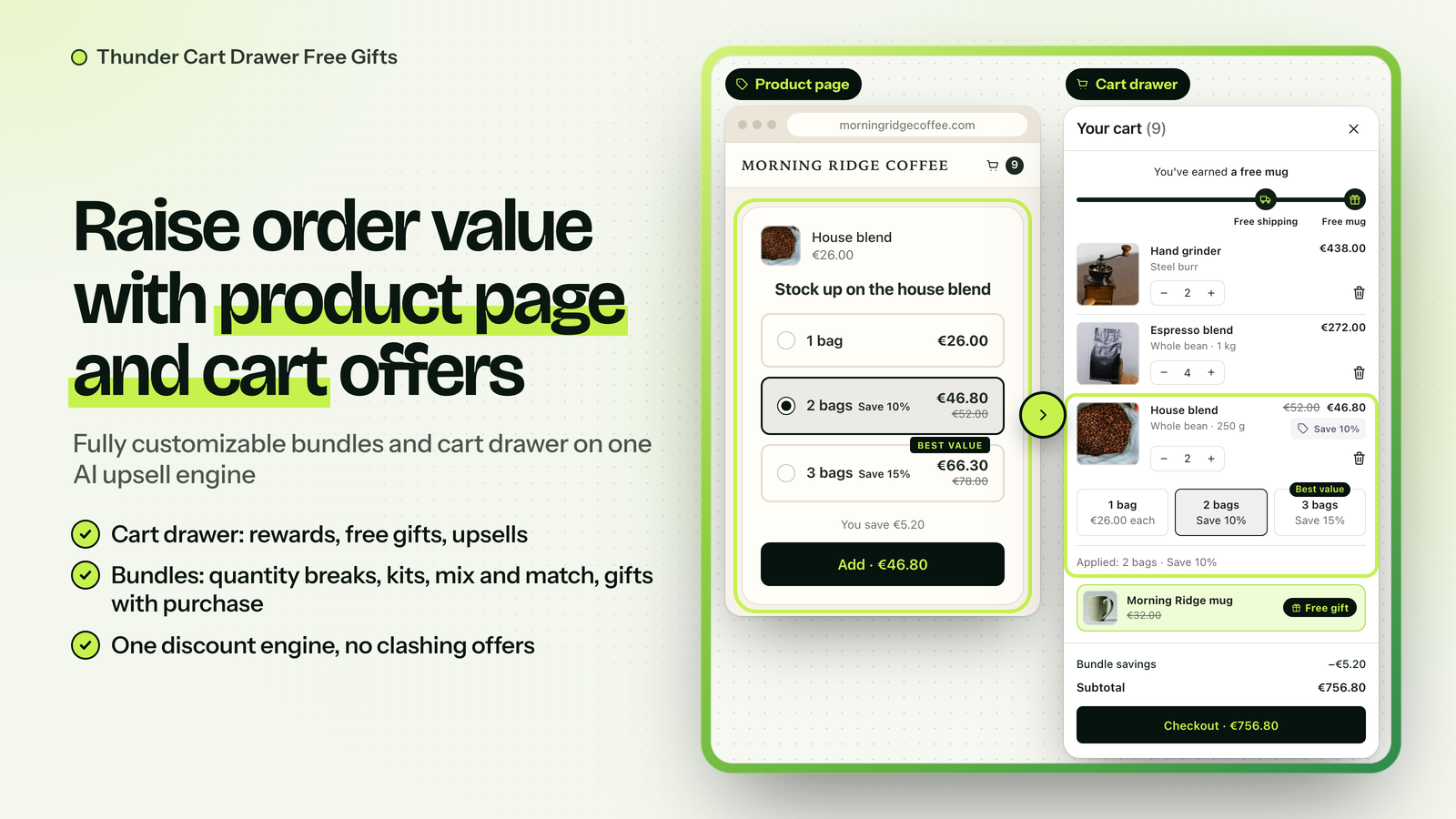
2. Raise order value with product page and cart offers
Subtitle: Fully customizable bundles and cart drawer on one AI upsell engine
Bullets:
- Cart drawer: rewards, free gifts, upsells
- Bundles: quantity breaks, kits, mix and match, gifts with purchase
- One discount engine, no clashing offers
Creative: the product page with a bundle widget, and the drawer with the same bundle carried in (complete-the-set / 2-pack). The bundle gets visibly carried from page to drawer.
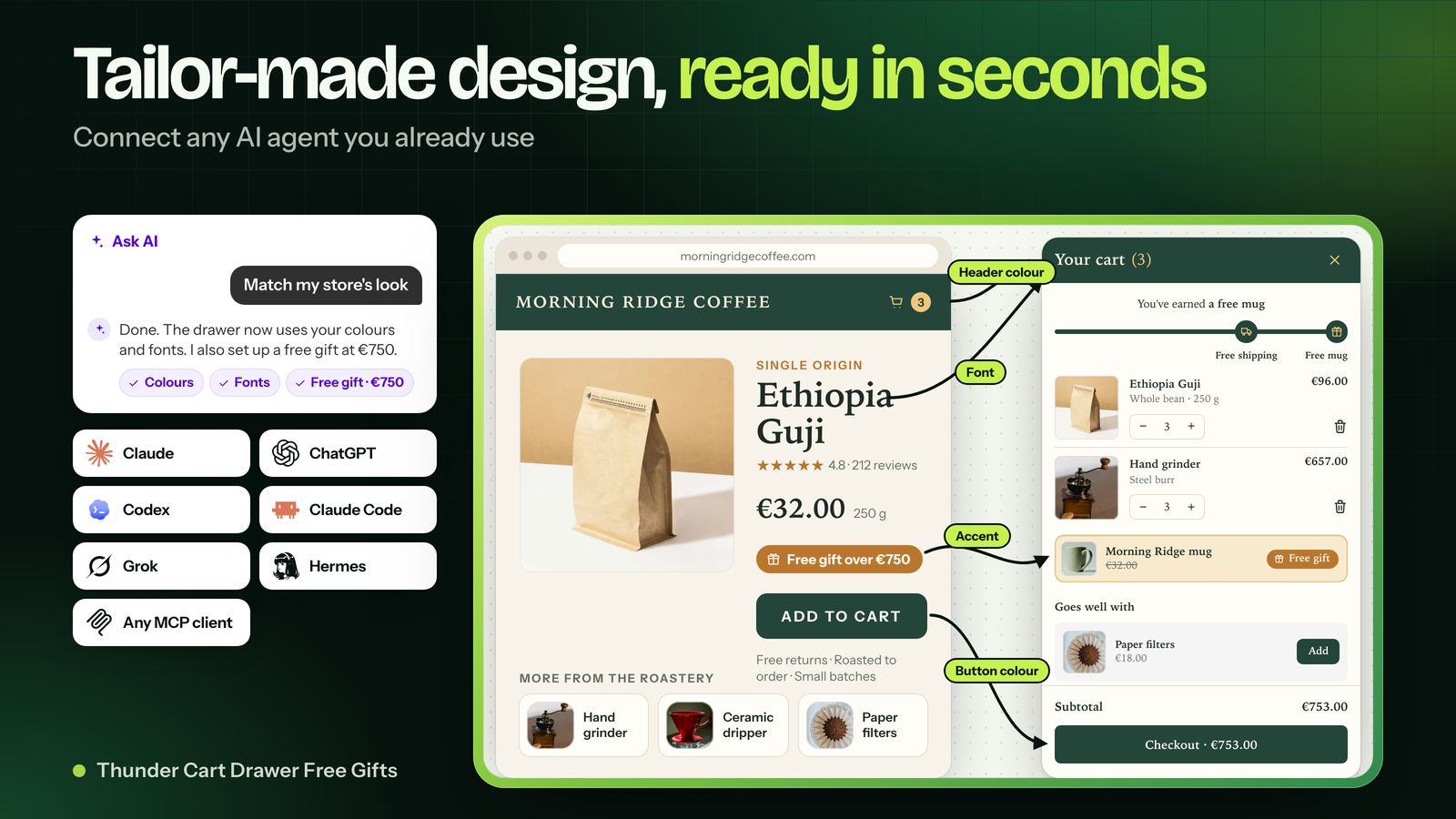
3. Tailor-made design, ready in seconds
Subtitle: Connect any AI agent you already use
Logo grid (with logos, 2 columns):
| Left | Right |
|---|
| Claude | ChatGPT |
| Codex | Claude Code |
| Grok | Hermes |
| Any MCP client | |
Creative, static, split 25 / 75:
- Left 25%: an AI chat. The merchant writes "Match my store's look". The assistant replies, briefly mentioning an offer it set up above (e.g. free gift at €60).
- Right 75%: a storefront with the cart drawer open. The drawer uses the storefront's colours and fonts. Arrows point from each storefront element (header colour, button colour, accent, font) to where it shows up in the drawer.
- Logo grid: in the left column under the chat, or as a strip. Pick whichever is cleaner.
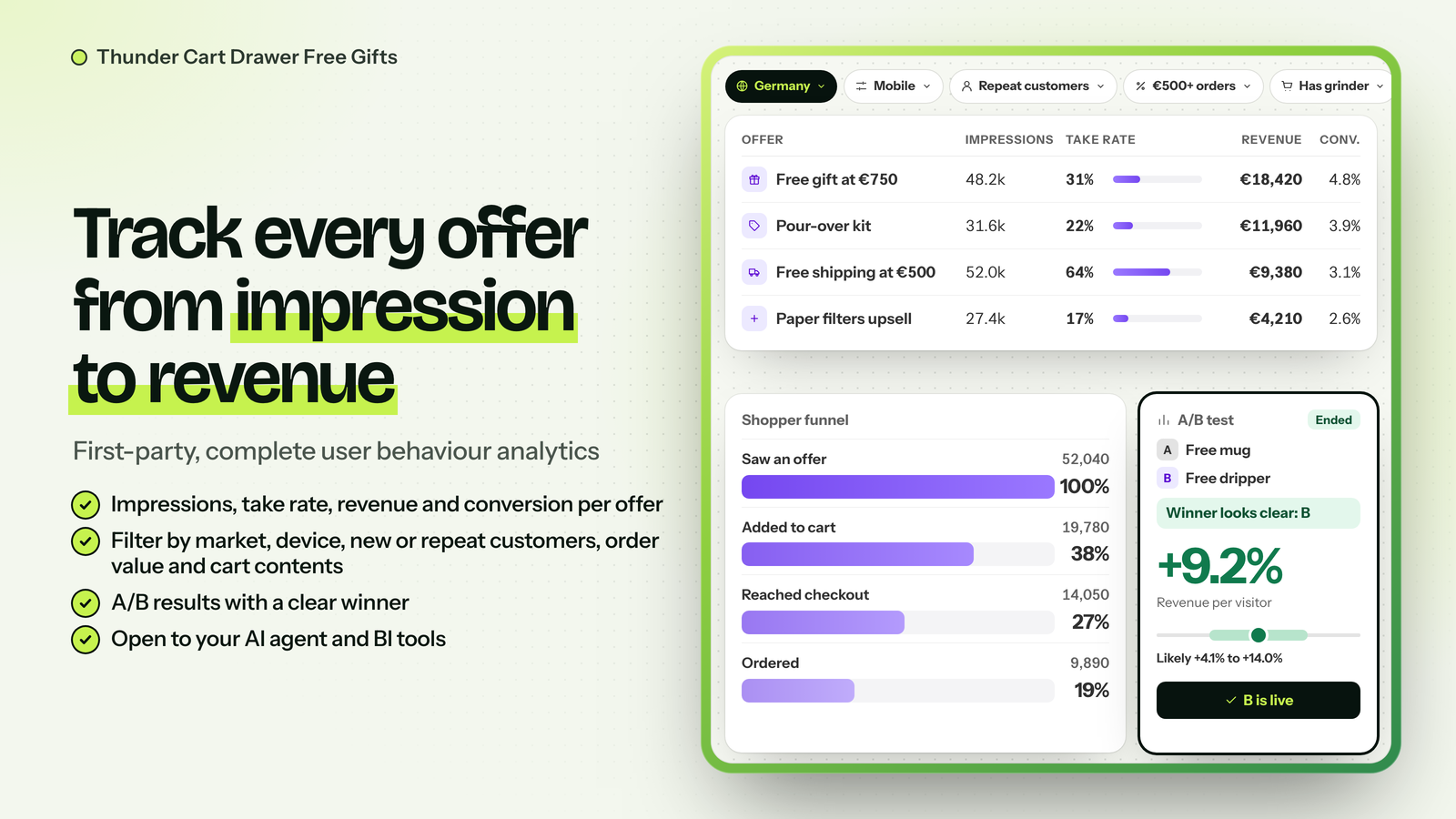
4. Track every offer from impression to revenue
Subtitle: First-party, complete user behaviour analytics
Bullets:
- Impressions, take rate, revenue and conversion per offer
- Filter by market, device, new or repeat customers, order value and cart contents
- A/B results with a clear winner
- Open to your AI agent and BI tools
Creative: an analytics view: revenue per offer table, the shopper funnel from view to checkout, filter chips (market, device, customer type), and the A/B result card inset ("Winner looks clear: B").
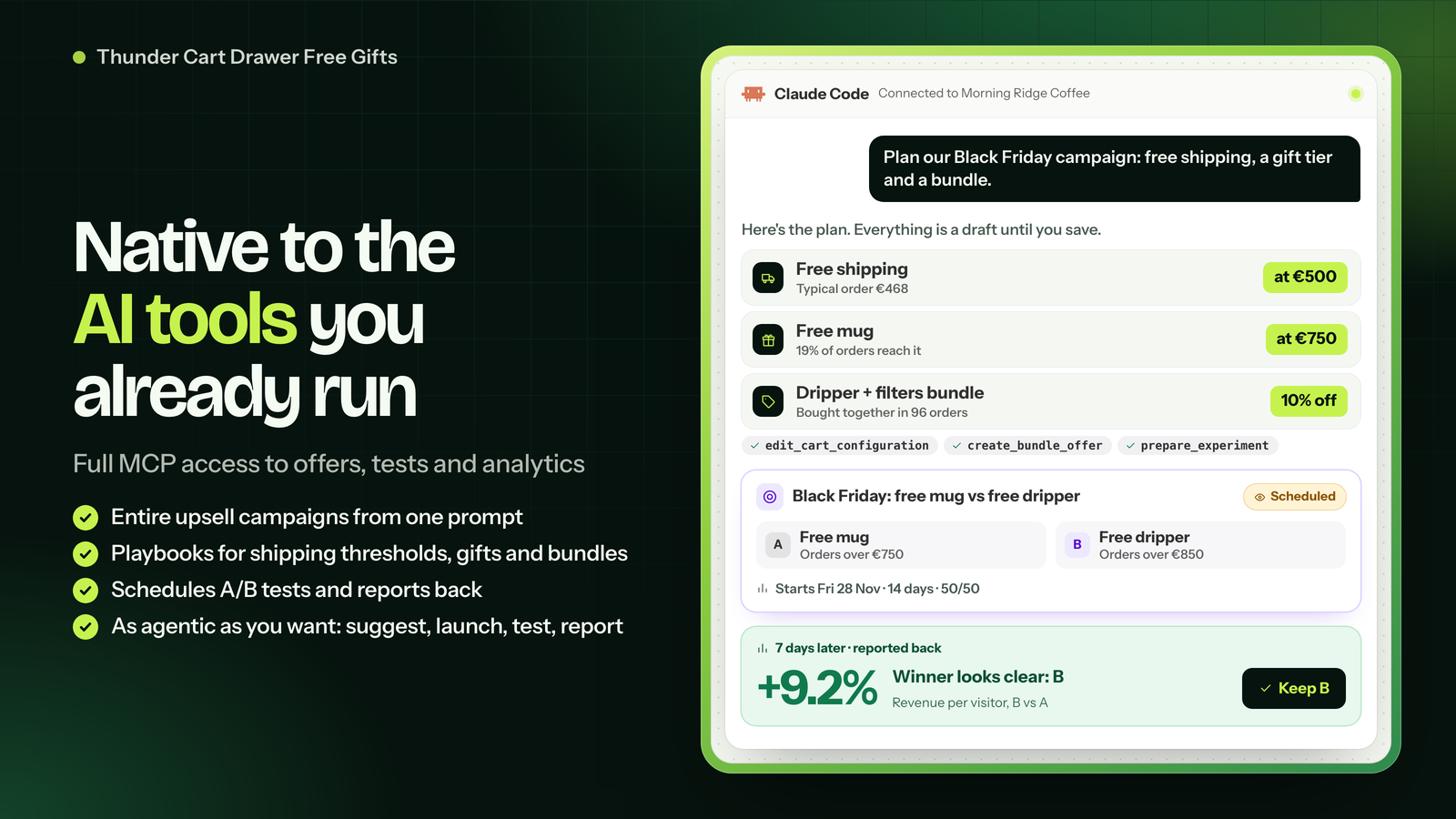
5. Native to the AI tools you already run
Subtitle: Full MCP access to offers, tests and analytics
Bullets:
- Entire upsell campaigns from one prompt
- Playbooks for shipping thresholds, gifts and bundles
- Schedules A/B tests and reports back
- As agentic as you want: suggest, launch, test, report
Creative: a single agent session (Claude Code or Claude style):
- The prompt asks for a Black Friday campaign.
- The agent replies with a short plan: free-shipping threshold, gift tier, bundle.
- An A/B test card appears, marked Scheduled.
- The result card reports back.
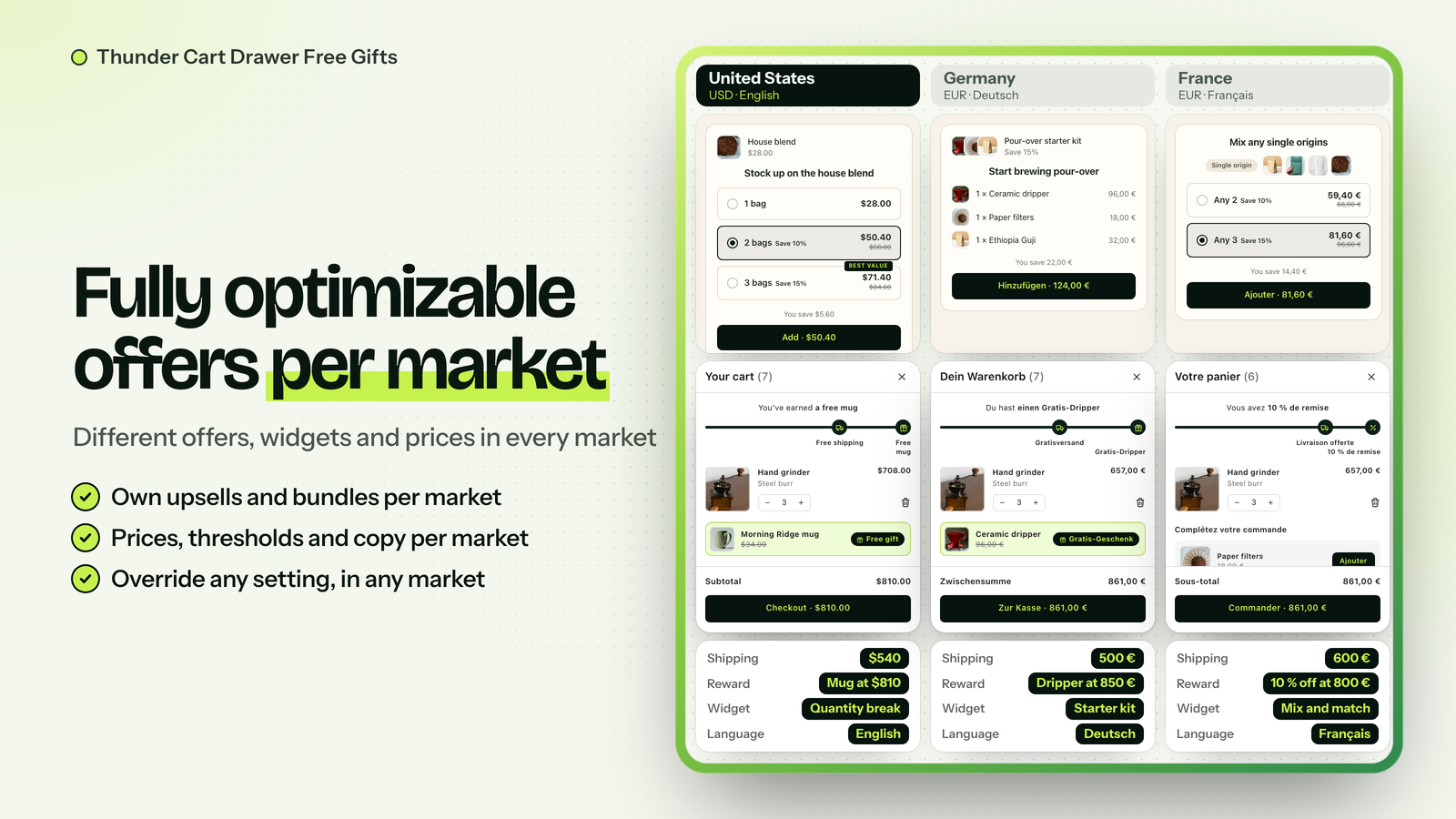
6. Fully optimizable offers per market
Subtitle: Different offers, widgets and prices in every market
Bullets:
- Own upsells and bundles per market
- Prices, thresholds and copy per market
- Override any setting, in any market
Creative: three markets side by side, each with its own drawer and product-page widget (different offers, currency, language), plus the per-market settings strip.
Design bar
Every slide matches the polish of the marketing site hero and the prototypes:
- the site kit
crocart-site/docs/motion-v2/*.png- the gift-rules prototype (https://cro-gift-rules.georgi-ae4.workers.dev)
Compact brand-coloured gifts, never the green "Choose your free gift" grid. No disclaimers or "demo" tags in the images.
How the deck got here
Deck history: v5.2 summary and open options
Listing deck v5.2: summary + open options
Settled
| # | Title | Subtitle | Bullets | Creative |
|---|
| 1 | Upsell and bundle engine for 8-figure stores | Data-backed and battle-tested on millions of orders | AI picks offers from your order data · First-party analytics on every offer · Built for every market you sell in | A polished analytics dashboard, the AI suggestion card and the drawer |
| 2 | Raise order value with product page and cart offers | OPEN (A) | Cart drawer: rewards, free gifts, upsells · Bundles: quantity breaks, kits, mix and match, gifts with purchase · One discount engine, no clashing offers | Product page + drawer, the bundle carried into the drawer |
| 3 | Tailor-made design, ready in seconds | Connect any AI agent you already use | Logo grid: Claude / ChatGPT · Codex / Claude Code · OpenClaw / Hermes · Any MCP client | OPEN (B) |
| 4 | OPEN (C) | First-party, complete user behaviour analytics | Impressions, take rate, revenue and conversion per offer · Filter by market, new and repeat customers · OPEN (D) · A/B results with a clear winner | Analytics: revenue per offer + shopper funnel, A/B result card inset |
| 5 | OPEN (E) | OPEN (F) | Entire upsell campaigns from one prompt · Playbooks for shipping thresholds, gifts and bundles · Schedules A/B tests and reports back · You approve before anything goes live | Agent prompt → campaign plan → scheduled A/B test → result |
| 6 | Fully optimizable offers per market | Different offers, widgets and prices in every market | Own upsells and bundles per market · Prices, thresholds and copy per market · Override any setting, in any market | Three markets, drawer + product-page widget differing |
| 7 | OPEN (G) | | | |
Design bar for every slide: the polish of the site hero and the prototypes (site kit, gift-rules prototype).
Options
A. Slide 2 subtitle: 1 Fully customizable bundles and cart drawer, one upsell engine · 2 Fully customizable bundles and cart drawer, powered by one data-backed engine · 3 Bundles and cart drawer, fully customizable, run by one upsell engine · 4 Fully customizable bundles and cart drawer on one AI upsell engine · 5 Every bundle and cart offer fully customizable, one engine behind them
B. Slide 3 creative: 1 Store URL in → AI reads the storefront → drawer appears in its fonts and colours (before/after split) · 2 Three different storefronts, three drawers, each matching its store · 3 Prompt "Match my store's look" → the drawer re-skins live over the storefront · 4 Colour and font swatches pulled from the storefront flow into the drawer and product-page widget · 5 Claude Code terminal writing the design on the left, drawer rendering on the right
C. Slide 4 title: 1 Measure every offer, and how shoppers react · 2 See how every offer performs, and why · 3 Every offer's performance, every shopper interaction · 4 Measure every offer, down to each interaction · 5 Track every offer from impression to revenue
D. Slide 4 extra bullet: 1 Full shopper funnel, from view to checkout · 2 Revenue attributed to each offer · 3 Compare offers side by side over time · 4 See where shoppers drop off in the cart · 5 Open to your AI agent and BI tools
E. Slide 5 title: 1 Plugs natively into your AI workflows · 2 Native to the AI tools you already run · 3 Fully agentic, or fully hands-on. Your call. · 4 Your AI runs your upsells, if you want it to · 5 Built into your AI workflows, not bolted on
F. Slide 5 subtitle: 1 Run it hands-on, or let your agent run everything · 2 As agentic as you want: suggest, launch, test, report · 3 From one prompt to a running campaign · 4 Your agent plans, launches and tests. You set the limits. · 5 Full MCP access to offers, tests and analytics
G. Slide 7: 1 Drop it (6 slides; Shopify's best practice is 3–6) · 2 "What your shoppers see": mobile drawer with rewards, compact gift, upsell, bundle (current) · 3 "The offers big stores run, built for your store": reward ladder, kit, 2-pack upgrade · 4 "Switch in minutes. AI rebuilds your setup." (no switching cost) · 5 "Built for peak traffic": Black Friday-ready speed and stability
Deck history: v5 proposal
Listing deck v5: proposal for discussion
| # | Title | Subtitle | Bullets | Creative now (v3) | Change to |
|---|
| 1 | Upsell and bundle engine for 8-figure stores | Data-backed and battle-tested on millions of orders | AI picks offers from your order data · First-party analytics on every offer · Built for every market you sell in | Order-value chart, suggestion card, drawer | Same layout, with one cue per bullet: the assistant's suggestion (AI), a revenue-per-offer figure (data), and a market switcher chip (markets) |
| 2 | Bigger orders, from product page to cart | Bundles and a cart drawer in one app, measured and A/B tested | Cart drawer: rewards, free gifts, upsells · Bundles: quantity breaks, kits, mix and match · One discount engine, no clashing offers | Product page + drawer with complete-the-set (v3 slide 5) | Keep. Add an arrow showing the product-page bundle landing in the drawer |
| 3 | Tailor-made design, ready in seconds | Connect any AI agent you already use | Agent grid, 2 columns × 3 rows, with logos: Claude, ChatGPT / Codex, Claude Code / Cursor, Any MCP client | New | A storefront with a drawer built in the store's own colours and fonts on the left; the agent grid on the right |
| 4 | Know how shoppers interact with every offer | First-party, complete user behaviour analytics | Views, clicks and adds for every offer · Revenue each offer earns, by market · A/B results with a clear winner | Two drawers plus a +9.2% A/B card | Analytics view (revenue by offer + funnel) with the A/B result card inset |
| 5 | Your agent runs offers and A/B tests | Connect once. It launches, schedules and reports back. | Launch an offer from one message · Schedule tests and promotions ahead · You approve before anything goes live | Agent tiles, terminal draft, drawer, Draft→Live line | The terminal asks for a scheduled test (e.g. a gift test for Black Friday weekend) → the A/B test card appears scheduled → the result. Agent tiles move to slide 3 |
| 6 | Fully optimizable offers per market | Different offers, widgets and prices in every market | Own upsells and bundles per market · Prices, thresholds and copy per market · Override any setting, in any market | Two market drawers + per-market settings table | Keep. Add a third market and show the product-page widget differing too |
| 7 | One drawer, every reason to add more | Rewards, free gifts, upsells and bundles in the cart | Rewards bar for shipping, discount and gifts · Compact free gifts in your brand colours · Bundles and upsells inside the cart | Drawer with callouts (v3 slide 4) | Keep |
Alternative titles for slide 5: "Let your AI agent run your offers" · "Your agent launches offers and runs tests".
Video: the same 7 messages
One beat per slide, with the same titles as captions so the listing reads as one story. Slide 2 becomes a fast montage (rewards → gift → upsell → product-page bundle → bundle in the cart). About 45 s.
New clips needed:
- Slide 3: AI builds a drawer in the store's style, then the agent grid.
- Slide 4: the analytics view.
- Slide 5: an agent schedules a test.
Already built: data read, A/B test, drawer features, bundles, markets, agent connect.
Images 1 and 2: 20 options each from ten copywriting methods (and the later image set)
Images 1 and 2: 20 new options each (v5)
10 copywriting skills, 2 options each. The angle, reasoning and compliance memo for each are in options/NN-<skill>.md and .compliance.md. ★ marks a skill's own best pick.
Image 1: what it is + why trust it
| # | Skill | Headline | Subtitle |
|---|
| 1 | Schwartz ★ | Upsells and bundles, chosen by order data | Proven on millions of real Shopify orders. |
| 2 | Schwartz | Upsells with millions of orders behind them | Data-backed upsell and bundle engine for Shopify. |
| 3 | Direct response ★ | Data picks every upsell and bundle | Upsell and bundle engine, battle-tested on millions of orders. |
| 4 | Direct response | Bigger orders, from offers chosen by data | Upsell and bundle engine, proven on millions of orders. |
| 5 | Wiebe ★ | Upsells and bundles, proven before you launch | Battle-tested on millions of orders, chosen from yours. |
| 6 | Wiebe | Your orders decide which upsells run | Upsell and bundle engine, battle-tested on millions of orders. |
| 7 | Dunford | Upsell and bundle engine for high-volume stores | Data-backed and battle-tested on millions of orders |
| 8 | Dunford ★ | Upsells and bundles decided by data | Battle-tested on millions of real orders |
| 9 | JTBD ★ | Upsell and bundle engine, proven at scale | Data-backed offers, battle-tested on millions of orders |
| 10 | JTBD | Upsells and bundles chosen by data | An upsell and bundle engine, proven on millions of orders |
| 11 | StoryBrand ★ | Upsells and bundles that arrive proven | Upsell and bundle engine, battle-tested on millions of orders |
| 12 | StoryBrand | Your busiest days run on data-backed upsells | Shopify upsell and bundle engine, battle-tested on millions of orders |
| 13 | Harry Dry ★ | Upsells picked by millions of orders | Data-backed upsell and bundle engine for Shopify |
| 14 | Harry Dry | Upsells that report what they earn | Data-backed offers, A/B tested, proven on millions of orders |
| 15 | Ogilvy | Upsell and bundle engine for 8-figure stores | Every offer data-backed, proven on millions of orders |
| 16 | Ogilvy ★ | Thunder raises order value with data-backed offers | The upsell and bundle engine proven on millions of orders |
| 17 | Psychology ★ | The upsell engine behind millions of orders | Data-backed upsell and bundle engine for Shopify stores |
| 18 | Psychology | Upsells built on how shoppers actually buy | Bundle and upsell engine, battle-tested on millions of orders |
| 19 | Hooks ★ | The upsell engine that proves every offer | Upsells and bundles, battle-tested on millions of orders. |
| 20 | Hooks | Upsell and bundle engine for 8-figure stores | Data-backed offers, proven across millions of real orders. |
Image 2: bundles and cart drawer in one app
| # | Skill | Headline | Subtitle |
|---|
| 1 | Schwartz | Bundles and cart offers that work together | Both measured by first-party analytics and A/B tests. |
| 2 | Schwartz ★ | Bigger orders from product page to cart | Bundles and a cart drawer, measured and A/B tested. |
| 3 | Direct response | Sell more from product page to cart | Bundles and cart drawer, one app, measured and A/B tested. |
| 4 | Direct response ★ | Prove every bundle and cart offer works | One app. Deep first-party analytics and A/B tests. |
| 5 | Wiebe ★ | Bigger orders from product page to checkout | One app: bundles, cart drawer, measured and A/B tested. |
| 6 | Wiebe | See which bundle or cart offer wins | One app, first-party analytics, A/B tests on both. |
| 7 | Dunford ★ | Bigger orders, from product page to cart | Bundles and cart drawer, with first-party analytics and A/B tests |
| 8 | Dunford | Bundle and cart offers that work together | One app, first-party analytics and A/B tests on both |
| 9 | JTBD ★ | Raise order value before and after add-to-cart | One app: bundles and cart drawer, measured and A/B tested |
| 10 | JTBD | Bundles and cart offers proven before launch | One app, first-party analytics and A/B tests on every offer |
| 11 | StoryBrand ★ | Bundles and cart lift you can prove | Deep first-party analytics and A/B tests, one app |
| 12 | StoryBrand | Bundles and cart offers that never clash | One app that measures and A/B tests every offer |
| 13 | Harry Dry | Bigger orders, from product page to cart | Bundles and cart drawer, measured and A/B tested |
| 14 | Harry Dry ★ | Bundles and cart upsells that never clash | One app. Every offer measured and A/B tested. |
| 15 | Ogilvy ★ | Sell more from product page to cart | One app: bundles and cart drawer, measured and A/B tested |
| 16 | Ogilvy | Only winning bundle and cart offers stay | One app runs both, with first-party analytics and A/B tests |
| 17 | Psychology ★ | Raise order value, product page to cart | Bundles and cart drawer in one app, A/B tested |
| 18 | Psychology | Test bundles and cart offers. Keep winners. | Measured with deep first-party analytics, in one app |
| 19 | Hooks ★ | Bigger orders, product page to cart drawer | Bundles and cart in one app, A/B tested and measured |
| 20 | Hooks | Bundles and cart offers that work together | One app, one discount engine, every offer measured, A/B tested |
Images 3–6, as you set them (subtitles drafted)
| Image | Headline | Subtitle |
|---|
| 3 | Design ready in seconds | Connect any AI agent: Claude, Claude Code, ChatGPT, Codex, Cursor, any MCP client |
| 4 | Know what every offer earns | First-party, complete user behaviour analytics |
| 5 | Have your agent run any offer or A/B test | Connect it once, then let it schedule and run them |
| 6 | Fully optimizable offers per market | Offers, widgets, upsells, prices and copy, set per market |
| 7 | One drawer, every reason to add more | Rewards, free gifts, upsells and bundles in the cart |
The ten writer versions (options for slides 1 and 2)
01 schwartz awareness
Image 1 and 2 headline options: Schwartz awareness stages
How the method applied
Traffic source is an App Store search or category browse for "upsell" or "bundle". Schwartz stage: Solution Aware (they know upsell and bundle apps exist, they don't know ours), with some Product Aware visitors comparing listings. The category is crowded, so every competitor already claims "boost AOV". At this stage the headline names the solution they are looking for, then adds the one mechanism or proof that separates it. A claim of outcome alone is skipped, because this market has heard it. Image 1 carries category plus mechanism plus proof. Image 2 carries the outcome they want, stated plainly, with the two jobs they now split across apps folded into it.
Image 1: what it is + why trust it
1A. Mechanism angle (Solution Aware)
- Headline: Upsells and bundles, chosen by order data
- Subtitle: Proven on millions of real Shopify orders.
- Angle: names the category they searched for, then the difference (data picks the offer, not a template). Proof goes in the subtitle so the headline works alone.
1B. Proof-scale angle (Product Aware)
- Headline: Upsells with millions of orders behind them
- Subtitle: Data-backed upsell and bundle engine for Shopify.
- Angle: leads with scale, the trust signal an 8-figure merchant scans for first. The subtitle states exactly what the product is.
Best pick, image 1: 1A. Visitors are Solution Aware, so the headline should say "upsells and bundles" (what they came for) and the mechanism (why this one is different). Scale stays one line below it as proof.
Image 2: bundles and cart drawer in one app
2A. Cohesion angle (Solution Aware)
- Headline: Bundles and cart offers that work together
- Subtitle: Both measured by first-party analytics and A/B tests.
- Angle: the benefit is that the two offer types behave as one system. Measurement closes it.
2B. Outcome angle (Product Aware)
- Headline: Bigger orders from product page to cart
- Subtitle: Bundles and a cart drawer, measured and A/B tested.
- Angle: leads with the result the merchant wants, over the full journey. The subtitle names both parts and the evidence behind them.
Best pick, image 2: 2B. The result is stated in the headline, it covers both product page and cart so the "two in one" idea comes through, and nothing in it reads as a feature list.
Word counts
All headlines are 7 words. Subtitles: 1A 7, 1B 7, 2A 8, 2B 9.
Compliance memo
Compliance memo: Schwartz awareness options (images 1 and 2)
To: Compliance. None of this is in the copy. The copy treats every claim as true and live.
Image 1
"Proven on millions of real Shopify orders" (1A subtitle) and "millions of orders behind them" (1B headline)
- Needs a substantiation file: which count (orders processed, orders touched by an offer, or orders analysed), the date, and the source. "Millions" must hold on the day the listing is published.
- "Proven" implies tested outcomes, not volume of processing. If the number is processed volume, "proven" is stronger than the evidence. "Behind them" in 1B implies the offers are derived from those orders. Confirm whether the engine learns from the pooled orders or only from each store's own orders.
- Whose orders? If pooled across merchants, check the merchant terms and privacy policy cover using their order data in aggregate. GDPR and CCPA apply to EU and California shoppers' data.
- Shopify's App Store listing rules prohibit unsubstantiated or misleading claims. Check the final wording against the current requirements for listing images.
"Chosen by order data" (1A headline)
- Does it hold for a store with few or no orders on day one? A new install has no history. If the engine falls back to defaults or catalog data, "chosen by order data" is overstated for those stores.
- "Order data" can be read as the merchant's own data. If some picks come from cross-store patterns, the headline is not exact.
"Data-backed" (1B subtitle)
- Only OK if every offer type carries a data reason. Check each offer type before using it.
"for Shopify" (both)
- Trademark use. The wording follows Shopify's partner brand guidelines as long as it doesn't suggest Shopify made or endorses the app. Confirm no "Built for Shopify" implication, since that badge is a separate program.
Image 2
"Bigger orders from product page to cart" (2B headline)
- A performance claim. It needs evidence that merchants see larger orders, ideally a measured average uplift, and the baseline and period. Without that, FTC and App Store claim rules apply. The claim is also universal ("bigger orders") rather than typical or average.
- Pair with merchant results or a stated measurement method in the substantiation file.
"work together" (2A headline)
- Implies bundle and cart offers never conflict. Confirm the engine prevents discount overlap in every case (stacking, Shopify discount combination limits). The brief's own source docs mention overlap warnings, which suggests conflicts can still occur and are surfaced rather than eliminated.
"first-party analytics" (2A subtitle)
- Define internally. It means the analytics are collected and owned by the app and not a third-party tool. Confirm that matches the architecture, and that the privacy policy and data-processing terms describe it.
- If it implies the merchant owns the data, confirm export and retention rights in the terms.
"measured and A/B tested" (2B subtitle) and "A/B tests" (2A subtitle)
- Applies to both bundles and the cart drawer. Confirm A/B testing is live for bundles as well as the cart, and not for the cart only.
- Test results carry statistical limits. Any results shown in other listing assets must not imply guaranteed uplift.
"Bundles and a cart drawer" in one app (2B subtitle)
- Confirm both are in the same plan tier. If bundles or the A/B tests sit in a higher tier, the listing and pricing section must be consistent.
General
- Superlatives and comparisons: none used. No "best", "#1" or named-competitor claims.
- Brand: no "CRO Cart" anywhere. The copy uses no brand name at all.
- Cross-check the final chosen lines against the other images for consistency of the "millions of orders" number and the analytics description.
02 direct response craft
Direct response craft: image 1 and image 2 options
Method used: master headline formula (action or outcome + specific detail + contrast), the So-What chain (feature to financial/emotional payoff), reason-why copy (Hopkins), specificity over adjectives. Every headline is ≤ 7 words and every subtitle ≤ 10.
Image 1: what it is + why trust it
Option 1A
Data picks every upsell and bundle Subtitle: Upsell and bundle engine, battle-tested on millions of orders. Angle: Reason-why. The headline says what it is (upsells and bundles) and why it's different (data picks them, not a merchant's hunch). The subtitle carries the battle-tested proof.
Option 1B
Bigger orders, from offers chosen by data Subtitle: Upsell and bundle engine, proven on millions of orders. Angle: So-What chain. Data-backed offers lead to bigger orders, which is the payoff an 8-figure merchant buys for. The mechanism sits inside the headline, the proof underneath.
Best pick for image 1
1A: "Data picks every upsell and bundle." It names the category and the difference in one read, with no claim a store owner has to decode. 1B has the stronger payoff but is the more generic line on an app-store page.
Image 2: bundles and a cart drawer in one app
Option 2A
Sell more from product page to cart Subtitle: Bundles and cart drawer, one app, measured and A/B tested. Angle: Journey outcome. One result, "sell more", across the whole path, with the contrast (product page to cart) doing the work of showing both parts. The subtitle names the two parts and the proof.
Option 2B
Prove every bundle and cart offer works Subtitle: One app. Deep first-party analytics and A/B tests. Angle: Proof. The merchant's fear is paying for offers that don't earn. This names both halves (bundle, cart) and the promise of evidence for each, and the subtitle gives the means.
Best pick for image 2
2B: "Prove every bundle and cart offer works." It says "bundles and cart" in the headline itself, so it reads as one app doing both, and it turns analytics plus A/B tests into a benefit (proof) rather than a feature list.
Compliance memo
Compliance memo: direct-response-craft options (images 1 and 2)
To: Compliance. Nothing in this memo is in the copy. The copy treats every claim as true and live.
Image 1
1A "Data picks every upsell and bundle"
- "Every" is an absolute. If any offer is merchant-set, defaulted, or overridden by hand, "picks every" is not literally accurate. Needs confirmation that data selects all offers the engine produces, or the headline should be treated as describing the engine's output only.
- "Data" is unspecified. Whose data: the merchant's own orders, or pooled data from other merchants? If pooled, there is a data-use and privacy disclosure question under the app's privacy policy and Shopify's partner data rules.
- "Battle-tested on millions of orders" (subtitle): needs a defensible source (count, date range, which stores). If the orders belong to merchants other than the listing's audience, say so internally. The number must remain true at listing time and at every future review.
1B "Bigger orders, from offers chosen by data"
- This is an outcome claim about order value. Shopify's app listing requirements prohibit unsubstantiated performance claims and guaranteed results. "Bigger" is comparative, with no baseline stated. Needs evidence (A/B or before/after data) before use. It is the riskiest line in my set.
- "Proven on millions of orders" (subtitle): "proven" asserts a result, not just exposure. Stronger than "tested". Needs the same substantiation as above, and arguably more.
- Combined with the headline, a reader could infer a guarantee of higher order value on their store.
Image 2
2A "Sell more from product page to cart"
- "Sell more" is an unbaselined performance claim. Same substantiation concern as 1B, though softer.
- "Measured and A/B tested" is fine if all bundle and cart offers actually can be A/B tested. Confirm it covers bundles on the product page as well as the cart drawer. If A/B tests exist for cart offers only, the subtitle overstates.
2B "Prove every bundle and cart offer works"
- "Prove ... works" can be read as a guarantee the offers will work. The product gives the merchant the means to see whether they work, and the copy can be read as promising they do. Confirm the legal read of "prove" as "enable you to prove".
- "Every" assumes complete analytics and test coverage on both bundles and cart offers. Confirm there are no offer types (e.g. some bundle types, free gifts, rewards) without analytics or test support.
- A/B test "proof" depends on traffic. Stores with low volume may never reach a clear result, so "prove" is not reachable for every offer on every store. This is a customer-expectation risk, not a legal one.
- "First-party analytics": confirm that this term is used the same way in the product docs and the privacy policy, and that the data is in fact collected by the app on the merchant's store, not via third-party trackers.
- "Deep" is a subjective superlative-adjacent word. Low risk, but flagging it.
General
- No Shopify trademark or Shopify-branded phrasing in the copy ("Shopify" is not used), so no trademark-usage issue. If a later version adds "for Shopify", the app-name/endorsement rules apply.
- No competitor comparison is made.
- "Millions of orders" appears in both image 1 options. One source of truth is needed for that figure, and the same number must be used everywhere on the listing and in the video.
- No brand name is used; "Thunder" is not needed.
03 conversion voc wiebe
03 · Conversion copywriting (Wiebe / Copyhackers): v5 options for images 1 and 2
Method: VOC first. Competitor 1★/2★ review language and the v3 VOC bank were mined for what an 8-figure buyer fears and asks. Copy then turned that language into titles and ran the 7 sweeps (clarity first, zero last). Compliance concerns are in 03-conversion-voc-wiebe.compliance.md, not here.
VOC that drove the options
| VOC (verbatim, competitor reviews) | Message it points to |
|---|
| "i didn't increase AOV with this APP" · "pricing plan should be based on the real AOV they bring" | This buyer has been burned. Trust must be shown, not claimed. |
| "I cannot be testing the app for them" · "rigorously test this app on a live store before relying on it" | Buyer does not want to be the guinea pig. They want it to arrive proven. |
| "it's load-bearing infrastructure for your revenue" | Bundles and upsells are core to revenue for 8-figure stores. Reliability matters most. |
| "Which offer should I even run?" | The decision is the pain. Data should make it. |
| "requires users to download a separate app for advanced analytics, which feels unnecessary and inconvenient" · "It didn't even appear in the app's analytics" | The buyer wants one app that both runs and measures every offer. |
| "discounts appear merged, which makes the cart experience confusing" · "conflicting with another discounting app" | Bundle and cart offers should be one coherent shopper journey. |
Image 1: what it is + why trust it
Option 1A
- Headline: Upsells and bundles, proven before you launch
- Subtitle: Battle-tested on millions of orders, chosen from yours.
- Angle: Proof-first. Speaks to the "I can't be your test" objection. The headline says what it is (upsells and bundles) and why it is different (arrives proven). The subtitle carries the millions-of-orders evidence and the data link.
Option 1B
- Headline: Your orders decide which upsells run
- Subtitle: Upsell and bundle engine, battle-tested on millions of orders.
- Angle: Data-first. Answers "which offer should I even run?" with your own order history. The headline gives the mechanism. The subtitle names the category and the trust proof.
Best pick, image 1: 1A
Trust is the strongest VOC barrier for this buyer. 1A puts the proof in the headline and keeps the data message in the subtitle. 1B is the better fallback if G wants "data" in the headline.
Image 2: bundles and a cart drawer in one app
Option 2A
- Headline: Bigger orders from product page to checkout
- Subtitle: One app: bundles, cart drawer, measured and A/B tested.
- Angle: Outcome across the whole path. Bundles work on the product page, the cart drawer works after add-to-cart, and one app covers both. The benefit leads. The measurement sits in the subtitle.
Option 2B
- Headline: See which bundle or cart offer wins
- Subtitle: One app, first-party analytics, A/B tests on both.
- Angle: Confidence in what works. Turns the "it didn't show in analytics" and "didn't increase AOV" pain into a verdict the merchant can see. It covers bundles and cart in one sentence.
Best pick, image 2: 2A
It reads as a benefit. A buyer gets the outcome in one second, and "product page to checkout" tells them both bundles and cart are in the app. 2B overlaps more with the analytics image.
Compliance memo
Compliance memo: conversion copywriting (Wiebe), v5 images 1 and 2
To: compliance team. From: copy option 03. None of this is in the copy. The copy treats every claim as true and live.
Image 1 options
1A "Upsells and bundles, proven before you launch" / "Battle-tested on millions of orders, chosen from yours."
- "Proven" is an objective performance claim. We need evidence that it holds for the engine's defaults, and a clear reading of what is proven (reliability, or results). The listing could be read as promising results.
- "Before you launch" implies validation has already happened for this merchant's store. That is not true of any single store. Check that nothing reads as a guarantee.
- "Millions of orders": needs a documented count, its date, and its source. It must be orders touched by the engine, not total merchant volume.
- "Battle-tested" is informal but still a reliability claim. The evidence should exist: uptime, incidents, peak-traffic handling.
- "Chosen from yours" says the engine picks offers from the merchant's own order data. This must match how the product works in practice, including the minimum order history. A new store has no history.
1B "Your orders decide which upsells run" / "Upsell and bundle engine, battle-tested on millions of orders."
- "Decide" suggests the data runs things automatically. Check against the product, where the merchant or agent approves and publishes. Overstating automation is a misrepresentation risk.
- Same millions-of-orders substantiation as above.
- Processing merchant order data to choose offers: confirm the privacy policy and Shopify data-use terms cover this, and that no shopper PII appears in screenshots.
Image 2 options
2A "Bigger orders from product page to checkout" / "One app: bundles, cart drawer, measured and A/B tested."
- "Bigger orders" is an outcome claim. It could read as a promise that order value rises. We need data to support it, or a plain reading as the aim of the features.
- "To checkout": the cart drawer and product-page bundles do not sit in checkout itself. Confirm the phrase does not imply changes to Shopify checkout, which carries restrictions (Plus-only extensibility, and so on).
- "Measured": the analytics must be first-party and complete, as in the owner's image 4. Keep the wording consistent.
- "A/B tested": confirm that A/B tests run on both bundles and the cart drawer.
- "One app": confirm both products are in a single install and a single bill.
2B "See which bundle or cart offer wins" / "One app, first-party analytics, A/B tests on both."
- "Wins" implies a result is always available. Statistical power depends on store traffic. A test may run without a clear winner.
- "First-party analytics" must be true: collected by the app, not by a third party, and access to it must be full. Check data residency and consent-mode handling.
- Same single-app confirmation as 2A.
Cross-cutting concerns
- Shopify App Store listing rules. Check the rules on image and listing text: superlatives, unverifiable performance claims, no pricing in images, no ratings or review quotes unless real, and no mention of other apps. None of my options uses a ranking or "best" claim.
- Competitor reviews as research. VOC came from public 1★ and 2★ reviews of other apps. No competitor is named and none of the quotes is used in copy. The reviews contain store names and developer replies that dispute some claims. Treat the quotes as perception, not fact. None of it is used to disparage anyone.
- Implied comparison. "Proven", "arrives proven" and "one app" are implicit contrasts with other apps. Check that this does not amount to comparative advertising that needs substantiation.
- "Data-backed" family. Both image 1 options rely on data language. Our data sources must be described accurately: order history, plus any aggregate learning across stores. If cross-store data is used, check merchant consent and contract terms.
- Agent and AI wording. I deliberately kept AI out of the image 1 and 2 headlines. Agent claims belong to image 3 and the AI-native image, where the owner has already approved wording.
- Brand. "CRO Cart" is not used. No brand name appears in the copy.
- Translation and markets. Claims should survive translation: "proven" and "battle-tested" may carry stronger legal weight in some jurisdictions (for example, EU consumer-protection reading of "proven").
04 positioning dunford
Copy v5 / 04 Positioning (April Dunford, Obviously Awesome)
Method used: the canvas first, then the headline. The headline has to name the category and the one attribute the alternatives lack. The subtitle carries the proof.
- Alternatives the buyer compares us to: a rule-based upsell app where every offer is a hunch; a separate bundle app next to a cart app; copying what a bigger store seems to run.
- Unique attribute: offers are decided from order data, and that approach has been run on millions of orders. Both bundles and the cart drawer are measured by first-party analytics and A/B tests.
- Best fit: Shopify stores with real order volume, who need to know why an offer is there.
- Category frame: a subcategory of what they already buy: the upsell and bundle engine, with "data" as the modifier. No education tax.
Image 1: what it is + why trust it
Option 1A: best-fit angle
Upsell and bundle engine for high-volume stores (7 words) Subtitle: Data-backed and battle-tested on millions of orders (7 words) Angle: names the category and the buyer. A large store sees itself in the title, and the subtitle gives the difference and the proof.
Option 1B: differentiator angle
Upsells and bundles decided by data (6 words) Subtitle: Battle-tested on millions of real orders (7 words) Angle: sets "decided by data" against the rule-based, hunch-driven alternatives. The title carries the category and the difference. The subtitle carries the trust.
Best pick, image 1: 1B. It puts "what it is" and "why it's different" in the title, and "why trust it" in the subtitle. Each message gets its own line.
Image 2: bundles and a cart drawer in one app
Option 2A: outcome angle
Bigger orders, from product page to cart (7 words) Subtitle: Bundles and cart drawer, with first-party analytics and A/B tests (10 words) Angle: sells the result, orders that grow at both stops of the buying path. The subtitle names the two features and the measurement behind them.
Option 2B: coherence angle
Bundle and cart offers that work together (7 words) Subtitle: One app, first-party analytics and A/B tests on both (9 words) Angle: sells the end of two apps pulling against each other, without naming an app. Both parts share one engine and one set of numbers.
Best pick, image 2: 2A. It states a benefit anyone understands in a second. 2B is the safer choice for a merchant who already runs two apps.
Compliance memo
Compliance memo: copy v5 / 04 Positioning (Dunford), images 1 and 2
To: compliance team. From: copy lead. Re: the four headline options in 04-positioning-dunford.md.
None of these concerns appear in the copy. Every claim was written as true and live at launch. No Shopify trademark is used and the brand name is not in the copy.
Rules cited (Shopify App Store requirements):
- 1.1.4: factual information only
- 4.3.3 and 4.3.4: no statistics or data in listing content or images; no "first/best/only"; no guarantees
- 4.4.4: images show the actual UI
Severity: High = likely flagged or needs substantiation; Medium = depends on reviewer or launch scope; Low = minor wording risk.
| # | Line | Concern | Rule | Severity |
|---|
| C1 | 1A, 1B subtitles: "millions of orders" / "millions of real orders" | A volume figure counts as data in listing media, even without digits. It needs substantiation if challenged: dataset, counting method, date. It must also be clear whether the figure counts orders that passed through Thunder or the data behind the defaults. | 4.3.3, 4.3.4, 1.1.4 | High |
| C2 | 1A, 1B: "battle-tested" | Marketing language that implies proven results. It rests on C1. If the order count is cut, the phrase has no support. | 1.1.4 | Medium |
| C3 | 1B: "decided by data" | Absolute. Merchants can add offers by hand, and some defaults may come from rules, not data. It holds only if the product's offers are chosen from order data by default. | 1.1.4 | Medium |
| C4 | 1A: "data-backed" | Same basis as C3. A reviewer may ask what data and how it is used. | 1.1.4 | Low |
| C5 | 1A: "high-volume stores" | Targets by store size and implies the app is used by large stores. It is not a statistic, but it suggests customers we should be able to point to. It may also read as excluding smaller merchants. | 1.1.4 | Low |
| C6 | 2A: "Bigger orders" | An outcome claim. It reads as a guarantee of higher order value and can be challenged without a measured result. The memo recommends leaving out any figure. | 4.3.4 (guarantee), 1.1.4 | High |
| C7 | 2A, 2B subtitles: "A/B tests" on bundles and the cart | The MCP experiments tool describes a cart experiment (live cart against a saved draft). I could not confirm that bundles can be A/B tested the same way. If A/B tests cover only the cart drawer, "A/B tests on both" and "bundles and cart drawer, with ... A/B tests" are not accurate. Confirm before publishing. | 1.1.4 | High until confirmed |
| C8 | 2A, 2B subtitles: "first-party analytics" | Confirm analytics cover bundle offers and cart offers with equal depth. "First-party" must mean the data is collected by the app, not pulled from Shopify reports. | 1.1.4 | Medium |
| C9 | 2B: "work together" | Implies no conflicts between bundle and cart discounts. The product has overlap warnings, not a guarantee that offers never clash. Merchants can still stack discounts into conflict. | 1.1.4 | Medium |
| C10 | 2A: "from product page to cart" | Needs bundles live on product pages and offers live in the cart drawer at launch. Check both ship together. | 1.1.4 | Low |
| C11 | All | The image UI must show what the headline says: bundles on a product page, the cart drawer, and an analytics or A/B screen. A headline with no matching UI element is open to challenge. | 4.4.4 | Medium |
| C12 | 1A, 1B, 2A, 2B | The headlines avoid "best", "first", "only", and naming competitors. The comparison to rule-based apps and two-app setups stays in the strategy notes, not the copy. | 4.3.4 | Low |
05 jtbd switching forces
05 · JTBD / switching forces: listing images 1 and 2
Job I wrote the copy for (no product named): "When my store is big enough that every point of order value is real money, I want to add offers I know will work, so I grow revenue without gambling the checkout I already have."
Forces: Push is guessing which offer to run, and offers that can't be measured. Pull is data-backed offers with proof. Anxiety is "will it hurt my conversion?". Habit is "my current setup works well enough." Copy for an 8-figure buyer has to lower Anxiety before it raises Pull, so image 1 leads with proof and image 2 leads with the moments covered and the testing.
Image 1: what it is + why trust it
1A
- Headline: Upsell and bundle engine, proven at scale
- Subtitle: Data-backed offers, battle-tested on millions of orders
- Angle: Anxiety first. The headline names the category (what it is) and the proof (why it's different) in one line. The subtitle supplies the evidence.
1B
- Headline: Upsells and bundles chosen by data
- Subtitle: An upsell and bundle engine, proven on millions of orders
- Angle: Push first. It names the frustration of guessing which offer to run, and the mechanism that ends it. The subtitle carries the category and the scale.
Best pick, image 1: 1A. An 8-figure merchant's blocker is risk, not interest. "Proven at scale" answers it in the title, and the category is in the same line.
Image 2: bundles and a cart drawer in one app
2A
- Headline: Raise order value before and after add-to-cart
- Subtitle: One app: bundles and cart drawer, measured and A/B tested
- Angle: The job's two moments. Bundles work on the product page before add-to-cart, and the drawer works after it. The benefit is covering both. Analytics and A/B tests sit in the subtitle as the proof.
2B
- Headline: Bundles and cart offers proven before launch
- Subtitle: One app, first-party analytics and A/B tests on every offer
- Angle: Anxiety reducer. The benefit is no blind rollout: you change either surface knowing what it earns. The subtitle states that it's one app.
Best pick, image 2: 2A. It reads as a result a merchant wants, not a feature list. It tells them the app works on both sides of add-to-cart before the subtitle adds the evidence.
Word counts
- 1A: 7 / 7 · 1B: 6 / 10 · 2A: 7 / 10 · 2B: 7 / 10
- "A/B" and "add-to-cart" are counted as one word each.
Compliance memo
Compliance memo: 05 JTBD / switching forces (copy v5, images 1 and 2)
To: compliance team. Nothing here is in the copy. The copy treats every claim as true and live. These are the points to check before publishing.
Claims in the copy that need substantiation
- "Proven at scale" (1A), "proven on millions of orders" (1B), "battle-tested on millions of orders" (1A subtitle). These are performance and scale claims. Confirm the order count and its source. Say whose orders they are: orders processed by the app, or orders analysed. Confirm the figure is still "millions" at publish date. "Proven" can read as a results guarantee, so check that the evidence shows the engine works and not only that it ran.
- "Data-backed" (1A subtitle) and "chosen by data" (1B). Confirm that offers are in fact selected from order data in the default flow, not only when the merchant asks for it. Check that merchants can see the data basis, if "data-backed" is read literally.
- "Raise order value" (2A). This is an outcome claim. No result is promised or quantified, but a reviewer may read it as an implied earnings claim. Check that we have evidence for typical uplift, and that the wording is accurate for stores where an offer loses an A/B test.
- "Before and after add-to-cart" (2A). Bundles are on the product page and the drawer is after add-to-cart. Confirm there are no bundle placements that break this (for example bundles inside the drawer), so it is not misleading about where each lives.
- "Proven before launch" (2B). Risk: an A/B test runs on live traffic, so the offer is already live to some shoppers while it is being tested. "Before launch" may overstate. If compliance is strict, this is the weaker option on accuracy. Suggested fix if needed: "proven before rollout", or drop to 2A.
- "Measured" and "first-party analytics" (2A and 2B subtitles). Confirm the definition: data collected by the app itself, owned and accessible to the merchant. Confirm the "every offer" scope covers both bundle and cart offers.
- "A/B tests on every offer" (2B). Confirm that every offer type, bundle and cart, can be put in an A/B test. If some types can't, "every" is false.
- "One app" (2A, 2B). Check that bundles and the cart drawer are one install and one billing relationship.
Shopify App Store listing rules to check
- No guarantees of results, no unsubstantiated superlatives or comparisons. "Proven" and "battle-tested" are the nearest to this line. We have no comparative claim against another named app.
- No pricing, ratings or reviews on listing images or in the title text.
- Screenshot and title text must match the shipped product. This includes the A/B and analytics claims in the subtitles.
- "Add-to-cart" is a generic term. "Shopify" does not appear in the copy. If it is added later, check Shopify trademark usage rules.
- "Thunder" is the only brand name allowed. It is not used in these options.
Privacy and data
- "Chosen by data" and "data-backed" imply the app processes merchant order data. The listing's privacy policy and data-use disclosure should say this, including any use for AI or recommendations.
- "First-party analytics" means shopper behaviour data collected on the merchant's store. GDPR and ePrivacy apply for merchants selling to EU/UK shoppers (consent, cookies or storage). Confirm that how the analytics collects data is covered by the privacy policy, and that the merchant's consent banner covers it.
- If "millions of orders" is built on data pooled across merchants, check that the merchants' terms allow this use and that the data is anonymised.
Advertising and consumer law
- The phrases "proven", "battle-tested", and "data-backed" are objective claims. Under EU/UK/US rules we should hold the evidence file before using them, and keep it current.
- A buyer could reasonably take "Raise order value" as meaning their own order value will rise. Consider where the listing shows the qualifier, for example in the description. The qualifier is not in the image copy.
Internal consistency
- 1A and 1B use the same scale claim. If the number changes, both must change. They also line up with image 4 ("Know what every offer earns"): the analytics wording in 2A and 2B has to match that image's subtitle (first-party, complete user-behaviour analytics).
- The headline claims for images 1 and 2 must agree with the AI-native image: the agent can run bundle and cart offers and A/B experiments.
- Brief says never "CRO Cart". This memo and the options use no product name.
06 storybrand sb7
06 StoryBrand (SB7): image 1 and image 2 options
Method: the merchant is the hero. They want to run offers they can trust. The villain is guesswork, and with two apps it is also two tools pulling in different directions. Thunder is the guide: empathy in the headline, authority (millions of orders, first-party data) in the subtitle. Each headline shows the success picture. Neither opens with "we".
Image 1: what it is + why trust it
Option 1A
- Headline: Upsells and bundles that arrive proven
- Subtitle: Upsell and bundle engine, battle-tested on millions of orders
- Angle: Success state. The hero's offers show up already backed by evidence. The headline names the things (upsells, bundles) and the difference (proven). The subtitle holds the authority.
Option 1B
- Headline: Your busiest days run on data-backed upsells
- Subtitle: Shopify upsell and bundle engine, battle-tested on millions of orders
- Angle: Stakes. It puts the hero's most valuable, highest-pressure traffic at the centre. The reader fills in the failure picture themselves: peak days on guesswork. The subtitle names the product and the proof.
Best pick, image 1: 1A. It says what the product is and why it differs in one read, with no scenario to decode. 1B is vivid but reads as a peak-day promise rather than a product definition.
Image 2: bundles and cart drawer in one app
Option 2A
- Headline: Bundles and cart lift you can prove
- Subtitle: Deep first-party analytics and A/B tests, one app
- Angle: Proof as the benefit. The hero gets lift they can show, not lift they hope for. The two surfaces are named, and measurement is carried by the word "prove".
Option 2B
- Headline: Bundles and cart offers that never clash
- Subtitle: One app that measures and A/B tests every offer
- Angle: Name the villain. Bundle and cart offers working against each other is the pain of running two apps. The benefit is peace of mind, and the subtitle adds measurement.
Best pick, image 2: 2A. "Lift you can prove" is the outcome an 8-figure operator buys, and it carries the analytics and A/B story as a result. 2B is more defensive, and "never clash" is an absolute.
Compliance memo
Compliance memo: 06 StoryBrand options (images 1 and 2)
Nothing here is in the copy. The copy treats every claim as true and live.
Claims to substantiate
- "Battle-tested on millions of orders" (1A, 1B subtitles). We need a documented count, a definition of "orders" (orders the app touched, orders analysed, or orders with an offer shown), and a date. The claim must stay true as numbers change. Check whether the figure includes test or development stores, and whether it is "millions" in the plural across the whole base or per merchant.
- "Proven" / "arrive proven" (1A, 2A). This can read as a guaranteed outcome or as pre-validation on the reader's own store. The evidence is aggregate order data and not a result for each merchant. The Shopify App Store prohibits unsubstantiated performance claims. Decide whether "proven" needs a support document, or whether we should fall back to "data-backed".
- "Data-backed" (1B headline). Define what the data is (the merchant's own orders, aggregate orders across merchants, or both). If it includes cross-merchant data, check privacy-policy coverage and merchant consent.
- "Lift you can prove" (2A). This implies the analytics and A/B tests demonstrate incremental lift. The tests must support that: attribution method, holdout design, significance handling. A merchant who reads this could expect positive lift. The copy does not promise lift, but the headline names it as the benefit.
- "Deep first-party analytics" (2A subtitle). "Deep" is a subjective superlative. "First-party" needs a consistent definition: data we collect directly from storefront events and orders, not a third-party tool.
- "Never clash" (2B). This is an absolute. Shopify discount combination rules and overlapping offers can still conflict. Earlier materials mention overlap warnings, which means clashes can be detected, not that they are impossible. If 2B is chosen, check what the engine guarantees.
- "Your busiest days run on..." (1B). This implies reliability and performance at peak traffic (BFCM and similar). We would need load or incident data. Also check the SLA wording.
- "Shopify" in the 1B subtitle. Trademark and branding: use must follow Shopify's brand guidelines and App Store listing rules (for example, no implying endorsement, and the app name or description rules).
- "Engine" / "upsell and bundle engine". This is descriptive. Check that it matches the category the app is listed under.
Listing policy checks
- No superlatives or comparisons ("best", "#1", "replaces X") appear in these options. Keep it that way in any edit.
- No competitor names, pricing, or free-trial language.
- Headlines and subtitles stay within the length limits (headline ≤ 7 words, subtitle ≤ 10).
- Brand: copy uses neither "CRO Cart" nor "Thunder" in the headlines.
Other concerns
- 1B uses "Your busiest days" to imply stakes. This is mild loss framing and not a scare claim, but a reviewer may read it as an implied outcome.
- 2B's "clash" frames other cart and bundle setups as a problem. It names no competitor, but check it against the App Store rule on disparaging comparisons.
- Any later edit that adds a number (percent lift, order count) needs its own substantiation.
07 concrete falsifiable dry
Harry Dry (concrete, falsifiable, ownable): image 1 and 2 options
Method applied: for each line I ran visualize / falsify / ownable. I dropped abstract verbs ("optimize", "unify", "power") and adjective claims ("best", "smart"). I kept only things you can point at: an order, a revenue number, a product page, a cart drawer. Each headline stands alone; each subtitle adds the proof.
Image 1: what it is + why trust it
Option 1A
- Headline: Upsells picked by millions of orders
- Subtitle: Data-backed upsell and bundle engine for Shopify
- Angle: Orders as the voters. The picture is a pile of real purchases choosing which offer you run. It says what it is (upsells) and why it's different (data chose them), and the subtitle names the category and adds bundles.
Option 1B
- Headline: Upsells that report what they earn
- Subtitle: Data-backed offers, A/B tested, proven on millions of orders
- Angle: Accountability. Every upsell comes with its own revenue line; a rival that can't show per-offer revenue can't sign it. The "millions of orders" proof moves to the subtitle.
Image 2: bundles and cart drawer in one app
Option 2A
- Headline: Bigger orders, from product page to cart
- Subtitle: Bundles and cart drawer, measured and A/B tested
- Angle: The shopper's path as the benefit. The picture is one order growing as the shopper moves from product page (bundle) to cart drawer (upsell). Falsifiable: order value is checkable.
Option 2B
- Headline: Bundles and cart upsells that never clash
- Subtitle: One app. Every offer measured and A/B tested.
- Angle: The conflict a two-app store lives with: a bundle discount and a cart offer stepping on each other. Benefit is clean offers, and "one app" is implied by "never clash" and stated in the subtitle.
Best pick per image
- Image 1: Option 1A, "Upsells picked by millions of orders". It carries both things G likes (data-backed, millions of orders) in the headline itself, with a one-second picture. The subtitle fixes the category for an 8-figure merchant.
- Image 2: Option 2B, "Bundles and cart upsells that never clash". It is the only line a competitor with one half of the product cannot sign, it names both halves, and the benefit is a problem the reader has already felt.
Compliance memo
Compliance memo: 07 concrete-falsifiable-dry (images 1 and 2)
Nothing here is in the copy. These are the concerns I had while writing.
Image 1
1A "Upsells picked by millions of orders" / "Data-backed upsell and bundle engine for Shopify"
- "Millions of orders" needs a documented, current count and a definition: orders processed, orders analyzed, or orders that carried an upsell. "Picked by" implies the orders influenced the choice of offers, so the substantiation should be about that, not just volume.
- If the orders include other merchants' data used to choose or rank offers, check the merchant data-processing terms, privacy policy and Shopify's protected customer data requirements for cross-merchant use. "Picked by millions of orders" could read as cross-merchant learning.
- "Data-backed" should be traceable to a described method (what data, which model or rule).
- "Shopify" appears in the subtitle in a descriptive sense. Check it is consistent with Shopify's app listing and trademark guidance, and that nothing suggests endorsement.
- "Upsells" alone in the headline leaves "bundles" to the subtitle; confirm the App Store listing name and category are consistent with "upsell and bundle engine".
1B "Upsells that report what they earn" / "Data-backed offers, A/B tested, proven on millions of orders"
- "Report what they earn" is a revenue-attribution claim. The attribution method (last-touch, A/B holdout, assisted) should be documented, and the merchant should be able to see it. Order-level revenue may overstate incremental revenue if no holdout is used.
- "Proven" is an absolute word. It sits beside "A/B tested" and "millions of orders"; confirm both are literally true for the product as shipped, not only for some features.
- "A/B tested" claims the product runs tests, not that every offer was tested. Make sure the screen it appears on does not suggest the second.
Image 2
2A "Bigger orders, from product page to cart" / "Bundles and cart drawer, measured and A/B tested"
- This is an outcome claim about merchants' revenue. Shopify's app listing rules and general advertising-substantiation rules expect support for performance claims. We need data on order value lift, with sample size and comparison method, or a basis that it is a typical result.
- Wording is comparative ("bigger") without a stated baseline. A baseline (versus no upsell or bundle) should be documented.
- "Measured" assumes first-party analytics cover both bundle and cart in the same view. Check this holds for every plan and market.
2B "Bundles and cart upsells that never clash" / "One app. Every offer measured and A/B tested."
- "Never" is absolute. If the product warns about overlaps rather than preventing them (the earlier listing copy used "overlap warnings"), "never clash" overpromises. Define what "clash" means (stacked discounts, duplicate offers, conflicting Shopify discount combinations) and confirm the product prevents it in every case, including with other apps' discounts and Shopify native discounts. Third-party apps and manually created discount codes are the likely gap.
- "Every offer measured and A/B tested" could read as "every offer is automatically tested". Confirm it means "can be measured and tested". The subtitle is a claim about capability, so the screenshot or video must not imply automation if there is none.
- "One app" is a competitive claim by implication (against two-app setups). It is not naming a competitor.
General
- No hedges were put in the copy per the brief; every claim above is therefore stated flat, and each needs substantiation on file.
- Neither "CRO Cart" nor "Thunder" appears in these lines. If the brand is added later, check the listing name rules for the App Store.
- "Millions of orders" appears in both image 1 options; the figure and its date should be the same everywhere it is used (listing text, video, images).
- Image 4 ("Know what every offer earns", first-party analytics) is already chosen. 1B repeats part of that idea (revenue per offer); if that overlap is unwanted, 1A avoids it.
08 ogilvy headline craft
Ogilvy headline craft: image 1 and image 2 options
Method used: lock positioning (what it does, who it is for), pick one promise, then write a headline that carries brand, benefit and a specific fact in plain words. The subtitle adds the proof. Hyphenated compounds (data-backed, 8-figure, first-party) count as one word.
Image 1: what it is + why trust it
Option 1A: flag the audience
- Headline: Upsell and bundle engine for 8-figure stores
- Subtitle: Every offer data-backed, proven on millions of orders
- Angle: Ogilvy's "flag your audience" rule. The headline names what it is and who it is for, so an 8-figure merchant sees himself in it. The subtitle gives the why-different and the proof.
Option 1B: brand + benefit + data
- Headline: Thunder raises order value with data-backed offers
- Subtitle: The upsell and bundle engine proven on millions of orders
- Angle: Ogilvy's brand + promise headline. The promise is a benefit (higher order value) and the mechanism (data-backed offers) sits in the same line. The subtitle names the product category and the proof.
Best pick, image 1: Option 1B. It is the only one that puts brand, benefit and mechanism in one glance, and it reads as a plain statement, not a slogan.
Image 2: bundles and cart drawer in one app
Option 2A: coverage as the benefit
- Headline: Sell more from product page to cart
- Subtitle: One app: bundles and cart drawer, measured and A/B tested
- Angle: The promise is the whole path from the first product page view to the cart drawer. Bundles and drawer are named in the subtitle, along with the measuring and testing.
Option 2B: only winners stay
- Headline: Only winning bundle and cart offers stay
- Subtitle: One app runs both, with first-party analytics and A/B tests
- Angle: The benefit is a clean store: every bundle and every cart offer has to win a test to stay. Both product types are named in the headline. The subtitle says they share one app and one analytics and testing system.
Best pick, image 2: Option 2A. Plain words, a benefit a merchant wants, and no jargon. Option 2B overlaps in meaning with image 4's measuring message.
Compliance memo
Compliance memo: Ogilvy headline craft, images 1 and 2
None of this is in the copy. Everything in the copy is written as true and live. These are the points to check before publishing.
Image 1
1A "Upsell and bundle engine for 8-figure stores" / "Every offer data-backed, proven on millions of orders"
- "8-figure stores" is an audience qualifier. It implies a revenue threshold. Confirm that stores below that threshold can install without friction, and that nothing reads as a restriction.
- "Every offer data-backed": confirm that every offer the product creates, including offers a merchant or agent writes by hand, is backed by data. If some offers are manual, "every" overstates.
- "Proven on millions of orders": confirm the total, what counts as an order, whether the orders come from many stores or one, and that the merchants whose orders were counted allowed their use as aggregate proof. Keep dated evidence for the number.
- "Proven" can read as a guarantee of results. Check Shopify App Store rules on performance claims and on proof wording.
1B "Thunder raises order value with data-backed offers" / "The upsell and bundle engine proven on millions of orders"
- "Raises order value" is an outcome claim. It needs substantiation: before-and-after or A/B evidence, and a clear basis such as average across stores. Check whether Shopify or advertising rules require a stated basis for a performance claim.
- Present tense and universal ("raises") may be read as applying to every store. Check that this holds for the stores we measured, including stores with few orders.
- "Data-backed": confirm what data. Merchant's own orders, pooled data across stores, or both. If pooled data crosses stores, check the privacy terms and the merchant data-use terms.
- Same "proven on millions of orders" points as above.
- The brand "Thunder" appears in the headline. Confirm trademark clearance and that the listing name and the headline name match.
Image 2
2A "Sell more from product page to cart" / "One app: bundles and cart drawer, measured and A/B tested"
- "Sell more" is a comparative outcome claim with no baseline. Check whether it needs a basis or evidence on file.
- "Measured": confirm analytics cover both bundles and cart drawer with the same definitions, so "measured" is not read as "attributed revenue is exact".
- "A/B tested": confirm A/B testing covers both bundles and cart offers today. If testing is only available for part of the cart, this overstates.
- "One app" is true only if no extra app, embed or theme edit is required for either piece. Check install steps.
- Merchant analytics use shopper behaviour data. "First-party" is used in the Option 2B subtitle. Check consent, cookie and privacy-policy wording for the markets we sell in (GDPR/ePrivacy, CCPA). Check that first-party is described accurately.
2B "Only winning bundle and cart offers stay" / "One app runs both, with first-party analytics and A/B tests"
- "Only winning offers stay" implies the product removes losers automatically. In practice the merchant decides. Check that the product does what the headline says, or that merchants cannot read it as an automatic promise.
- "Winning" needs a definition: which metric (revenue per visitor, conversion, or another), what sample size, and what significance. Check that the product does not declare winners on thin data.
- "First-party analytics": confirm the data is collected on the merchant's own domain, and that the wording is accurate for cart events and for orders.
- Same "One app" install check as 2A.
General
- Word counts treat hyphenated compounds (data-backed, 8-figure, first-party) as one word. If the listing tool counts them as two, 1A and 1B move to 8 headline words and the 1A subtitle to 9.
- The copy uses "Shopify" nowhere, so there is no third-party trademark issue in these lines. Option 1A names stores generally, not Shopify.
- No testimonials, ratings or third-party names appear in any of the four headlines or subtitles.
- The headlines avoid "best", "#1", "guaranteed" and "revolutionary". Check whether "proven" and "winning" need to be treated at the same level.
- Check with whoever owns the App Store listing review: some listing reviews treat "millions of orders" as a claim that needs a source at submission.
09 behavioral psychology
Option set 09: behavioral psychology (Cialdini, Kahneman, Fogg)
Method: for each image I named the decision the buyer is making, the bias that gets in its way, and the model that clears it. Image 1 is a trust decision, so I used social proof and the availability heuristic (a vivid, concrete scale beats an abstract "proven") and Map ≠ Territory (real behaviour beats assumptions). Image 2 is a "why two surfaces, one app" decision, so I used Fogg's Prompt model (two prompts, two moments) and regret/loss aversion (a test removes the fear of adding an offer that hurts conversion).
Image 1: what it is + why trust it
Option 1A
- Headline: The upsell engine behind millions of orders
- Subtitle: Data-backed upsell and bundle engine for Shopify stores
- Angle: Social proof and availability. The scale sits in the headline as a vivid, concrete picture. "What it is" is the noun, and the subtitle adds bundles and data.
Option 1B
- Headline: Upsells built on how shoppers actually buy
- Subtitle: Bundle and upsell engine, battle-tested on millions of orders
- Angle: Map ≠ Territory. Offers come from observed purchase behaviour, not assumptions or hunches. The battle-tested proof moves to the subtitle.
Pick for image 1: 1A. An 8-figure merchant gets the category (upsell engine) and the proof (millions of orders) in one glance. The proof is a number, not an adjective.
Image 2: bundles and cart drawer in one app
Option 2A
- Headline: Raise order value, product page to cart
- Subtitle: Bundles and cart drawer in one app, A/B tested
- Angle: Fogg's Prompt. A shopper can be nudged at two moments, before add-to-cart and after. The headline states the benefit, and the two surfaces appear only as the range of it.
Option 2B
- Headline: Test bundles and cart offers. Keep winners.
- Subtitle: Measured with deep first-party analytics, in one app
- Angle: Regret and loss aversion. The fear of adding an offer is that it might cost conversion. Testing first removes that fear, so only offers that earn stay.
Pick for image 2: 2A. It leads with the outcome a merchant wants (more per order) and covers both surfaces. 2B is the stronger answer to the fear of adding offers, but it describes a mechanism more than a benefit.
Word counts: all four headlines are 7 words. Subtitles: 1A 8, 1B 9, 2A 9, 2B 8.
Compliance memo
Compliance memo: behavioral-psychology options (images 1 and 2)
To: compliance. None of this is in the copy, because the copy is written as if every claim is true and live. These are the points I'd want you to check before it ships.
Image 1
- "Millions of orders" (1A headline, 1B subtitle). Needs a defensible source: orders that passed through Thunder offers, not total store GMV or orders on stores that merely installed it. State which count it is, over what period, and who counted.
- "Behind millions of orders" (1A). "Behind" implies Thunder produced or influenced those orders. If the number covers orders where no Thunder offer was shown, the wording overstates.
- "Data-backed" (1A, 1B). Implies offers are selected from actual data. Confirm that holds for default setups and new stores with little order history, not only mature ones.
- "Battle-tested" (1B subtitle). Puffery in normal use, but it sits next to a number, so it will be read as a factual claim. Same substantiation as point 1.
- "How shoppers actually buy" (1B). Implies behavioural data on shoppers is processed. Check the privacy policy and the Shopify data-processing disclosures (GDPR/UK GDPR, CCPA/CPRA) cover order-level and session-level analysis, and that this is the same data the listing says is first-party.
- "Upsell engine" / "for Shopify stores". Nothing here suggests Shopify endorses or certifies the app. Keep it that way in the final layout (no Shopify logo marks beyond the permitted badge).
- Overlap with prior rounds. 1A and 1B are new constructions, but they carry the same "millions of orders" message as the v4 H slot, so any substantiation issue found there applies here too.
Image 2
- "Raise order value" (2A). An outcome claim. Even phrased as a goal, it can be read as a promise of uplift. Check there is evidence for an average uplift, and whether the app-store reviewers and ad regulators (FTC, ASA, Shopify App Store requirements on performance claims) would want a "results vary" qualifier outside the image. No figure is stated, which helps.
- "Product page to cart" (2A). Check the bundle widget works on all supported theme types (Online Store 2.0, headless) as the listing implies. Cart drawer coverage should match.
- "A/B tested" (2A subtitle). Confirm the A/B testing works for both bundles and the cart drawer, not just the drawer.
- "Keep winners" (2B). Implies a winner always emerges. Some tests are inconclusive, and the product may declare no winner. Same for "only offers that earn stay": if the product does not auto-remove losers, "keep winners" is merchant action, not automatic.
- "Test bundles and cart offers" (2B). Check experiment scope: if bundle experiments are not available, this overstates.
- "Deep first-party analytics" (2B subtitle). "First-party" means data the merchant collects through their own storefront. Confirm Thunder's data collection matches that definition, and that cookie/consent behaviour is described correctly (EU and UK consent rules).
- "In one app" (2A, 2B subtitle). Fine as a fact if both modules ship in one install. Avoid pairing it with anything that says "replaces your other apps", which G already rejected and which would also be a competitor-comparison claim.
Psychology ethics
- No scarcity, urgency, countdown or fear-of-missing-out devices are used in either image. I used loss and regret aversion only in the sense of "removing the fear of a bad offer" (2B). If anyone strengthens that into "stop losing sales", it would need a basis.
- Social proof is a number, not a testimonial or a named logo. No customer endorsements or logos are implied.
- Brand: "Thunder" is not used in any headline or subtitle. "CRO Cart" appears nowhere.
Word counts
All headlines are 7 words. Subtitles: 1A 8, 1B 9, 2A 9 ("A/B tested" counted as two words), 2B 8.
10 video hook tactics
Options: 10 video-hook-tactics
Method: pick the tactic (Motion hook taxonomy) that fits an 8-figure, Product-Aware/Solution-Aware buyer scanning the App Store, then write the headline as a plain title in the buyer's own words. Hook tactics here are the frame only; the listing format (title, not slogan) keeps them quiet.
Image 1: what it is + why trust it
1A. Headline: The upsell engine that proves every offer Subtitle: Upsells and bundles, battle-tested on millions of orders. Angle: Bold Claim + Authority (trigger: Social Proof/Credibility). Names the category in the first four words, then the difference: every offer carries its own proof. The "millions of orders" evidence sits in the subtitle, so the headline survives alone.
1B. Headline: Upsell and bundle engine for 8-figure stores Subtitle: Data-backed offers, proven across millions of real orders. Angle: Demographic Callout (trigger: Identity Call-Out). The right buyer self-selects by revenue tier in one glance; category and audience in the headline, data and scale in the subtitle.
Image 2: bundles + cart drawer in one app
2A. Headline: Bigger orders, product page to cart drawer Subtitle: Bundles and cart in one app, A/B tested and measured. Angle: Aspirational outcome (trigger: Aspiration/Desire). Leads with the result the merchant wants and the journey it covers. Both products are implied by the two places named; measurement is in the subtitle.
2B. Headline: Bundles and cart offers that work together Subtitle: One app, one discount engine, every offer measured, A/B tested. Angle: Pain-avoidance benefit (trigger: Pain Agitation, framed positively). The multi-app headache of offers colliding is the unspoken pain; the headline states the relief. Different from 2A: coordination, not size.
Best picks
- Image 1: 1A. "The upsell engine that proves every offer" says what it is and why it is different in one read. It is the only option where the trust claim sits in the headline itself (proof per offer) and not just in the subtitle. 1B is a strong fallback if G wants the 8-figure buyer named.
- Image 2: 2A. A benefit a merchant wants (bigger orders), stated plainly, covering both product page and cart drawer. 2B is the fallback if G prefers the no-clash angle.
Word counts checked by hand: every headline is 7 words (8-figure counted as one), every subtitle is 8 to 10.
Compliance memo
Compliance memo: 10 video-hook-tactics, listing images 1 and 2
To: Compliance team. None of these concerns appear in the copy. Each line below needs a yes/no from you before publishing.
Image 1
1A "The upsell engine that proves every offer"
- "Proves every offer": implies each offer has measured results available. Confirm that analytics and A/B testing cover every offer type (upsells, bundles, cart-drawer offers), not only A/B-tested ones. Merchants with low traffic may see "not enough data" and read "proves" as a guarantee.
- "Proves" can be read as "proves it works" (a performance guarantee) rather than "shows the evidence". Confirm the meaning we can stand behind is "shows what each offer earns".
- Subtitle "battle-tested on millions of orders": need a source for the order count (what exactly is counted, which period, across how many shops). Confirm "millions" is true on the date of publication and that it counts orders processed with Thunder offers, not all orders on installed stores.
- "Upsells and bundles": confirm Shopify App Store rules allow a category claim ("engine") without a rating or review reference.
1B "Upsell and bundle engine for 8-figure stores"
- "8-figure stores" implies annual revenue of at least 10 million (in what currency?). Confirm we have merchants at that tier and that the claim is "built for" and not "used by". Check that it is not read as a restriction (smaller stores excluded) or an endorsement by those stores.
- Subtitle "data-backed": the strength of the data claim depends on what the data is (merchant's own orders, a pooled dataset, or research). Confirm which one, and whether pooled data across merchants is covered by our terms and privacy policy.
- "Proven across millions of real orders": same sourcing requirement as 1A. "Proven" is a stronger word than "tested" and may be read as a results guarantee; confirm we are comfortable.
Image 2
2A "Bigger orders, product page to cart drawer"
- This is an outcome claim (higher order value). Confirm we have evidence that offers increase order value, for what share of merchants, and over what period. If not universal, a regulator may read it as a typical-results claim.
- It compares implicitly with the merchant's current orders; there is no baseline stated. Confirm that is acceptable.
- "Product page to cart drawer": confirm both placements are available on all plans and all themes, including the online-store 2.0 requirement for product-page blocks.
- Subtitle "A/B tested and measured": confirm A/B testing is available to every merchant who installs, not only paid tiers, and that "measured" refers to first-party analytics owned by Thunder (not Shopify analytics).
2B "Bundles and cart offers that work together"
- "Work together" implies no discount conflicts. Confirm what the discount engine actually guarantees: does it prevent stacking with other apps' discounts, or only with Thunder's own offers? A merchant who runs another discount app may read this as a guarantee across apps.
- Subtitle "one discount engine": confirm technically accurate, given Shopify discount functions limit on stacking and the combinations rules.
- "Every offer measured, A/B tested": same availability check as 2A.
General (all four options)
- Brand: "Thunder" is not used in these options. If it is added later, confirm trademark clearance for use alongside Shopify marks.
- Numbers, "millions", "8-figure": ensure the evidence file is kept so the claim can be substantiated on request (App Store review, advertising-standards complaint).
- "First-party analytics": confirm the data-collection and consent position (cookies, GDPR/ePrivacy for EU shoppers) behind the analytics promise is complete, since two of the four subtitles lean on measurement.
- None of the copy mentions AI, agents or guaranteed revenue; if G later merges these with image 3 or 4 copy, re-check those claims separately.